
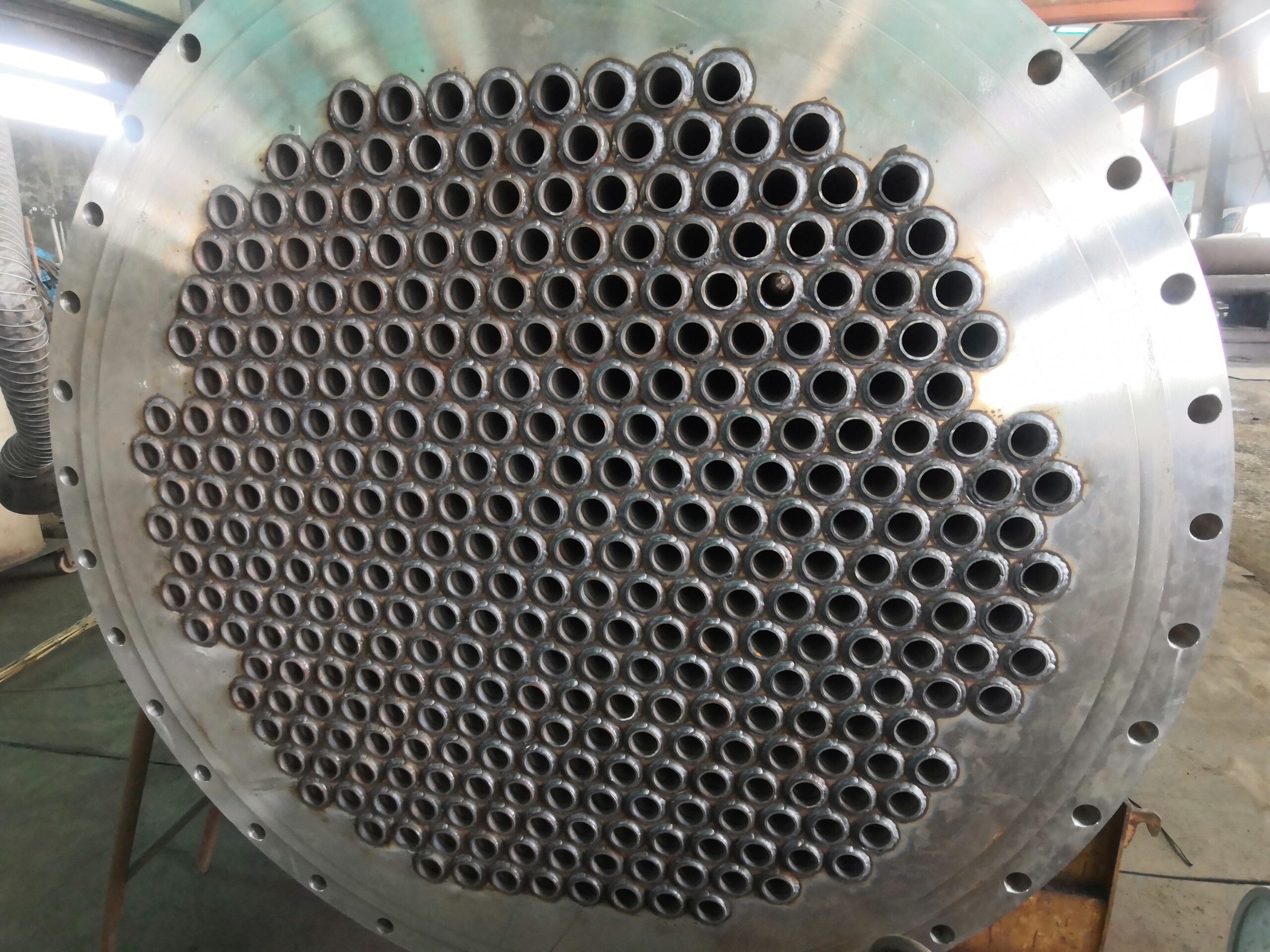
Industrial Heat Exchangers, Condensers & Evaporators Shandong Bojing Chemical Machinery Co., Ltd. delivers rigorous technical verification and high-reliability custom fabrication based strictly on client-provided design institute blueprints. We focus heavily on cross-checking overall heat transfer coefficients (*U*-value), fluid velocities, and Pitting Resistance Equivalent Numbers (PREN) to safeguard high-chloride coastal factory operations and maritime cooling streams. […]

Industrial Heat Exchangers, Condensers & Evaporators

Shandong Bojing Chemical Machinery Co., Ltd. delivers rigorous technical verification and high-reliability custom fabrication based strictly on client-provided design institute blueprints. We focus heavily on cross-checking overall heat transfer coefficients (*U*-value), fluid velocities, and Pitting Resistance Equivalent Numbers (PREN) to safeguard high-chloride coastal factory operations and maritime cooling streams.

Technical Specifications
ParameterCustom Fabrication & Verification Range
Heat Transfer Area1 ㎡ to 1,500 ㎡ (Manufactured strictly to client blueprint specifications)
Materials of ConstructionShell Side: SUS304, SUS316L, SUS321 | Tubes & Tube Sheets: Pure Titanium (TA1/TA2), Duplex Steel 2205, Titanium-Steel Clad Plate
Available ConfigurationsFixed Tube Sheet, U-Tube, Floating Head, Spiral Plate, and Double Pipe Layouts
Design Pressure RangeTube Side: Up to 4.0 MPa | Shell Side: Up to 4.0 MPa (100% hydrostatic verified)
Operating TemperatureExcellent thermal compliance supporting stable operations from -196°C up to 400°C
Manufacturing CodesASME Section VIII Div.1 Compliant Specifications, China GB/T 151, and GB150
Main Product Features

Optimized Material Selection

Corrosive-contact tubes leverage pure titanium or titanium-steel clad plates, while non-contact outer shells utilize standard stainless steel to optimize capital asset costs.

Marine & High-Chloride Resilience

Specialized non-ferrous metallurgy absolutely eliminates localized pitting, stress corrosion cracking, and salt spray degradation in harsh coastal water loops.

Advanced Anti-Fouling Surface

Precision finished inner pipe matrices minimize fluid particulate attachment and organic scaling resistances, drastically reducing shutdown cleaning frequencies.

Extended Thermal Lifecycle

Premium mill certificate traceability ensures verified fatigue endurance, offering significantly longer service lifespans under intense交变 fluid cycling conditions.

Blueprint Verification Process

01. Thermal Balance Review

We cross-check thermal metrics and fouling factors to verify the original design's overall heat transfer coefficient (*U*-value).

02. Velocity & Pressure Drop Verification

Re-calculations are executed for tube/shell flow rates to prevent un-calculated fluid resistance from straining upstream pumps.

03. Anti-Vibration Mechanical Checklist

We review baffle plates pitch, tie-rods structures, and tube bundle mechanical clearances to eliminate fluid-induced resonance vulnerabilities.

04. Certified Welding & Hydro-Testing

Welding maps follow ASME criteria (including advanced ladder-welding for clad material). NDT探伤 and standalone shell/tube hydro-tests are executed.

Maritime Protection & Global Delivery

Prior to dispatch, all heat exchangers, condensers, and evaporators undergo meticulous internal flush-outs and external surface passivations. Precision flange faces are securely sealed with robust blanks. Units are securely bolted to heavy-duty export steel cradles, wrapped in multi-layer anti-corrosive shrink film, and fortified with rust-inhibiting vacuum barrier envelopes to prevent salt corrosion during maritime long-distance transit.

Engineering Technical FAQ
Q: What crucial parameters do your technical teams verify upon receiving third-party heat exchanger blueprints for high-corrosion plant streams?
A: We focus heavily on verifying fluid velocity distributions and fouling resistances. If the blueprint's original layout features fluid velocity boundaries that are too low, particulate matter will settle rapidly on tube walls, causing heavy fouling thermal resistance. If too high, excessive pressure drops will degrade plant pump lifecycles. We recalibrate these key boundaries against real workshop machining limitations and suggest modifications to the design institute or client whenever vulnerabilities are discovered.
Q: When utilizing titanium for core tubes and stainless steel for the shell, how does Bojing resolve dissimilar metal fusion boundaries under severe thermal cycling?
A: Pure titanium and stainless steel cannot be directly fusion-welded due to catastrophic metallurgical cracking tendencies under intermetallic phases. To overcome this engineering barrier under intense thermal cycling, we strictly implement advanced Titanium-Steel Clad Plate (钛钢复合板) welding techniques. In our facility, titanium tubes are strength-welded to the titanium cladding layer using specialized high-purity argon TIG parameters, while the steel shell is joined to the robust carbon steel base layer. This eliminates dissimilar interface issues entirely, ensuring a 100% zero-leakage guarantee under severe deep-cryo (-196°C) or high-temp (400°C) processing boundary states.
shell and tube heat exchanger diagram showing shell side, tube side,baffles and tube sheet

The shell and Tube Heat Exchanger

The shell and tube heat exchanger is one of the most widely used heat exchanger types in industry. This section covers shell-side and tube-side construction, baffle arrangement, heat transfer and pressure drop calculation, and selection guidelines, with a structure diagram for easy reference.Learn more about Heat Exchangers/Condensers/Evaporations

U-Tube heat exchanger structure daigram showing shell side,tube side,U-tube bundle and baffles

The U-Tube Heat Exchanger

The U-tube heat exchanger is an important type of shell and tube heat exchanger. Its U-tube bundle is fixed at one end to the tube sheet and free at the other, effectively absorbing thermal expansion. This section covers shell-side and tube-side construction, baffle arrangement, heat transfer and pressure drop calculation, and selection guidelines, with a structure diagram for easy reference.

Scroll to Top

NEED HELP?

WELCOME TO CONTACT US

we are always ready to provide you with better quality and services. Welcome to contact us or visit our company and factory in the following ways

Contact Us